QT/QTc on Apple Watch ECG — what ECG+ measures and what to do
ECG+ calculates your QTc interval from every Apple Watch ECG recording and flags it when the value looks prolonged. This page explains what QT and QTc actually mean, what a raised reading might indicate, and — importantly — why a single-lead ECG has real limitations for this specific measurement. Use ECG+ as a tracking and reference tool, not as a diagnostic one.
What is the QT interval?
Each heartbeat on an ECG produces a recognisable sequence of waves. The QT interval spans from the start of the QRS complex to the end of the T wave — it represents the time the heart's lower chambers (ventricles) take to contract and then fully recharge before the next beat.
Because the QT interval naturally shortens at faster heart rates and lengthens at slower ones, clinicians use a corrected value called QTc, which adjusts for heart rate and allows meaningful comparison across recordings. ECG+ calculates and displays QTc for every recording.
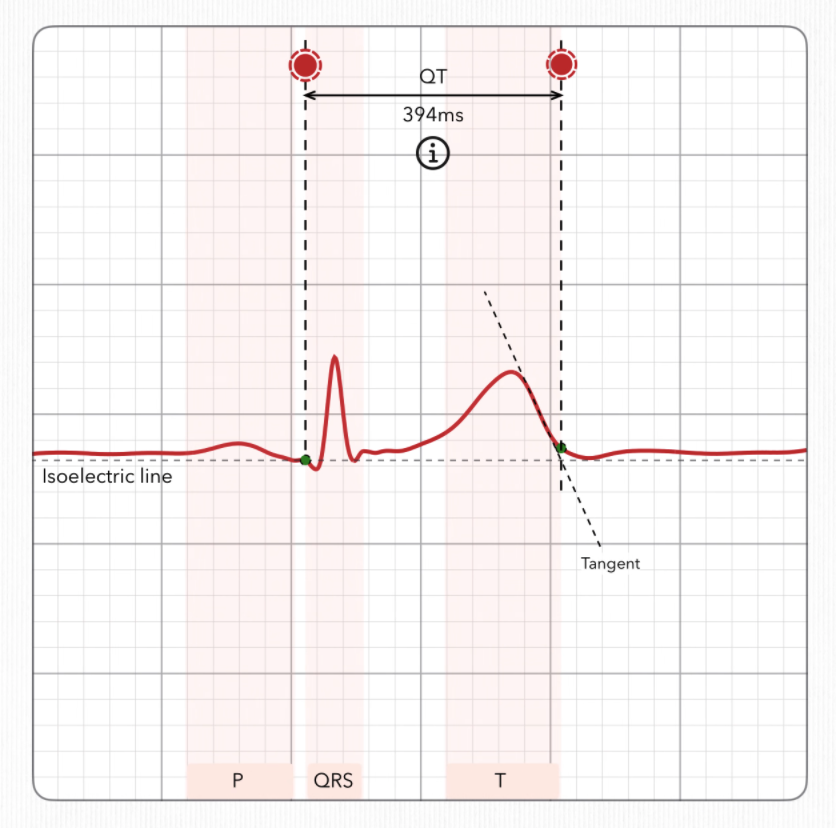
General QTc thresholds used in clinical practice:
| Category | Men | Women |
|---|---|---|
| Normal | Under 440ms | Under 460ms |
| Borderline | 440–460ms | 460–480ms |
| Prolonged | Above 460ms | Above 480ms |
| High risk | Above 500ms in either sex | |
Why single-lead ECG has limits for QTc
This is the most important thing to understand about QTc on Apple Watch ECG.
Apple Watch records a single-lead ECG. In clinical practice, QTc is measured across multiple leads — particularly leads II, V5, and V6 — because different leads capture the T wave from different angles. The longest QT interval found across those leads is the clinically meaningful value.
A single lead may not capture the T wave endpoint clearly, particularly when the T wave is flat, biphasic, or merges with a U wave. Small errors in locating the end of the T wave translate directly into errors in the QTc value. Movement artefact, poor electrode contact, or a short recording duration compound this further.
ECG+ applies established correction formulas to calculate QTc as accurately as the signal allows — but the underlying single-lead limitation remains. Treat the value ECG+ shows you as a useful reference and a prompt to look more closely, not as a confirmed clinical measurement.
What a raised QTc might mean
A prolonged QT interval means the heart's electrical recovery phase is taking longer than typical. In some cases this is temporary and reversible — the most common causes include:
- Medications — certain antibiotics, antidepressants, antipsychotics, and antiarrhythmics are known to prolong QT
- Electrolyte imbalances — low potassium, magnesium, or calcium levels
- Thyroid disorders — particularly an underactive thyroid
- A naturally slower heart rate — which lengthens QT even in healthy people
In some people, Long QT is congenital — present from birth due to a genetic variant affecting the heart's electrical channels. This is less common but worth knowing about, particularly if there is a family history of unexplained fainting or sudden cardiac events.
Should I be concerned?
A single raised QTc reading from a single-lead ECG is not a diagnosis. Many things can produce a temporarily elevated value — a slow heart rate at the time of recording, a slightly noisy signal, or a T wave that was hard to measure accurately.
That said, consistently raised readings or a value above 500ms is worth bringing to your doctor, especially if you have any symptoms such as dizziness, fainting, or palpitations. Your doctor can arrange a 12-lead ECG, which provides a much more reliable QTc measurement, and check whether any medications or electrolyte levels might be a factor.
ECG+ is useful here because it lets you see your QTc across multiple recordings over time. A pattern of consistently elevated values is more meaningful than any single result.
A good next step
- Take several recordings at different times of day to see whether the raised QTc appears consistently or only occasionally.
- Note any symptoms — dizziness, palpitations, or fainting — and review any medications that might affect QT.
- Mention it to your doctor — share your ECG+ report and ask for a 12-lead ECG if readings are consistently elevated or above 500ms.
Frequently asked questions
Can Apple Watch measure the QT interval?
The native Apple Watch ECG app does not report the QT or QTc interval; it only classifies the overall rhythm. ECG+ calculates QTc from the recording, though single-lead measurement has limits compared with a 12-lead ECG.
What QTc is considered dangerous?
A QTc above roughly 500 ms is generally considered high-risk, but thresholds vary by sex and clinical context. A raised reading should be confirmed with a 12-lead ECG.
Is a single-lead QTc reliable?
It gives a useful estimate, but a single lead can miss or misjudge the end of the T wave, especially when the T wave is flat, biphasic, or merges with a U wave. A 12-lead ECG provides a more reliable value.