PVC on Apple Watch ECG — what it means and what to do
If ECG+ flagged a PVC in your recording, the first thing to know is this: premature ventricular contractions are one of the most common heartbeat variations there is. Most people have them at some point, and for the vast majority, they are completely harmless.
A PVC is simply a heartbeat that fires a little early, from the lower chambers of the heart rather than following the heart's usual electrical pathway. Your heart resets itself after each one and carries on as normal.
What does a PVC feel like?
Many people never feel them at all. When they are noticeable, a PVC typically feels like:
- A skipped beat or a brief pause
- A stronger-than-usual thump after the pause — that's your heart resuming its normal rhythm
- A flutter or brief heaviness in the chest
That thump can feel alarming in the moment, but it is just your heart catching up — nothing is going wrong.
How ECG+ identifies a PVC
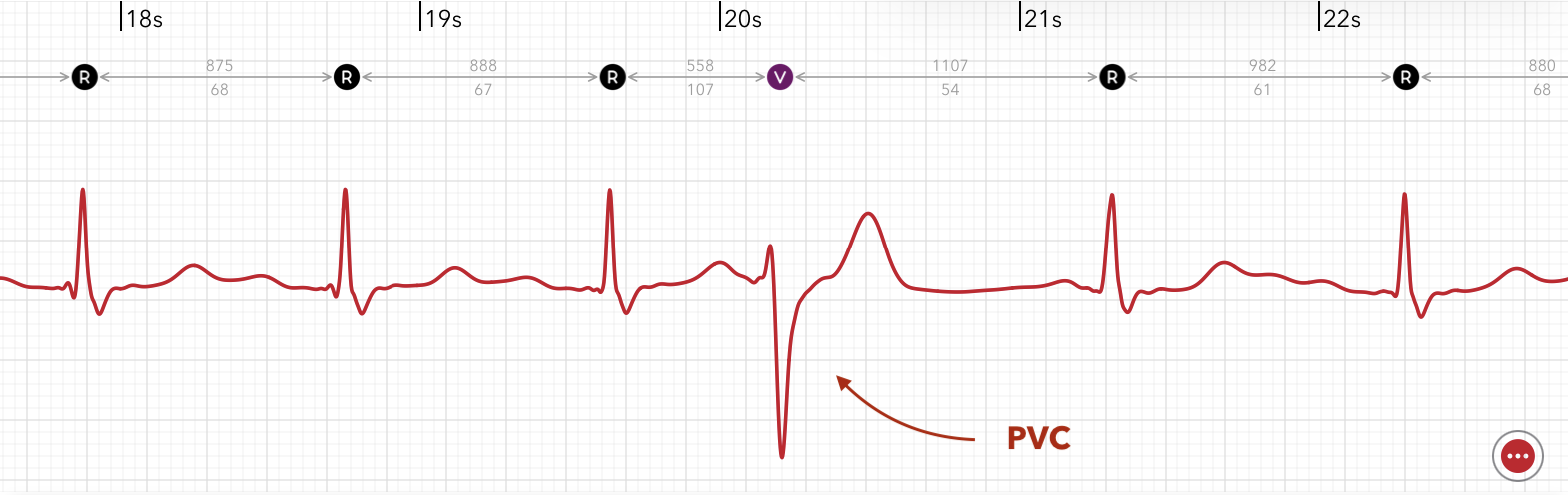
On your Apple Watch ECG, a PVC has a recognisable shape — a wider, more pronounced wave that stands out from the surrounding beats. ECG+ looks for these characteristics and marks the beat with a  badge — the V stands for ventricular — so you can see exactly where it occurred in your recording.
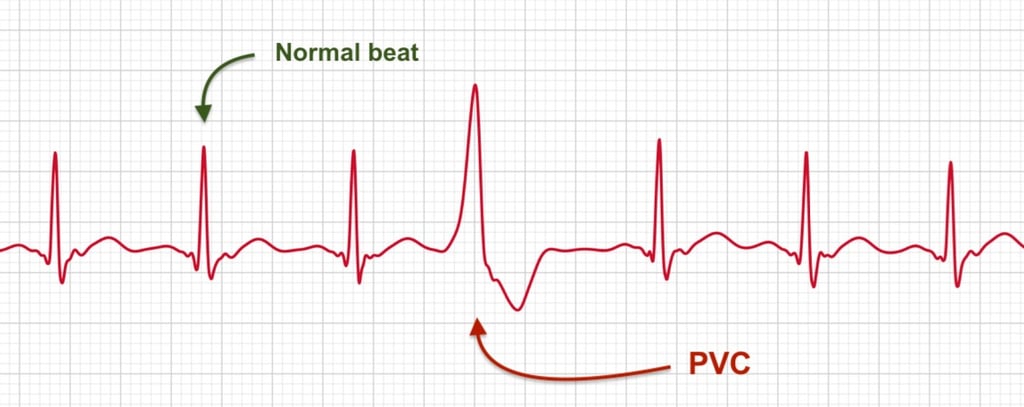
Here is another example — the wider, taller beat in the middle is the PVC, standing out clearly from the normal beats on either side:
PVC patterns you might see
Sometimes PVCs appear on their own, and sometimes they fall into a repeating pattern. ECG+ names these patterns so you have the right words if you speak with a doctor:
ECG+ also calculates your PVC burden — the share of all beats in a recording that are PVCs — so you can track how things change over time.
PVC vs PAC — what is the difference?
Your ECG+ report may show both PVCs and PACs, and it is worth understanding what sets them apart. Both are early beats, but they come from different parts of the heart.
A PVC originates in the ventricles — the lower chambers — and travels an unusual electrical route, which is why it produces that wide, distinctive wave on the ECG. A PAC originates in the atria — the upper chambers — and follows the normal pathway, so it looks much more like a regular beat.
PVCs tend to feel more noticeable because the compensatory pause before the next beat is slightly longer, making the following beat feel stronger. PACs are often subtler. For most people, neither is cause for concern — ECG+ tracks them separately so you can see exactly what is happening across your recordings over time.
Things that can bring on PVCs
PVCs often have a direct cause, and knowing yours can make a real difference. Common triggers include:
- Caffeine — coffee, energy drinks, strong tea
- Poor sleep or fatigue
- Stress or anxiety
- Alcohol
- Dehydration
- Intense exercise, especially if you are not well rested
If you notice PVCs appearing after any of these, that context is worth noting and worth mentioning to your doctor.
Should I be concerned?
For most people, occasional PVCs need no treatment at all. That said, it is always worth mentioning them to your doctor, particularly if they are happening often, if the pattern has changed, or if they come with dizziness or chest discomfort. Your doctor can decide if anything further is needed — and in most cases, the answer is simply to keep an eye on things.
The value of ECG+ here is that you arrive at that conversation with real data rather than just a description of how you felt.
A good next step
- Take a few more recordings over the coming days to see whether PVCs appear consistently or only occasionally.
- Note any triggers — what you ate, drank, or were doing before recordings where PVCs appear.
- Share with your doctor — ECG+ lets you export your recordings as a PDF report, which gives your doctor something concrete to look at.
Frequently asked questions
Can Apple Watch detect PVCs?
The Apple Watch ECG app does not label PVCs; it only reports the overall rhythm such as sinus rhythm or AFib. ECG+ analyses the recording to identify and count premature ventricular contractions. When PVCs are frequent, the app may instead return an inconclusive result, because the recording falls outside the rhythms it's built to classify.
How many PVCs per day is normal?
Occasional PVCs are normal, and many healthy people have hundreds a day without any problem. What matters more is the burden as a percentage of total beats, with a sustained burden above about 10% more likely to be reviewed by a doctor.
Are PVCs dangerous?
In people with healthy hearts, occasional PVCs are usually harmless. Persistent high-burden PVCs, or PVCs with symptoms, are worth discussing with a doctor.
What causes PVCs?
Common triggers include caffeine, stress, poor sleep, alcohol, dehydration and electrolyte imbalances.