What to ask your doctor about your Apple Watch ECG
Your Apple Watch ECG picked up something worth looking at. Now you have an appointment with your doctor and you want to make the most of it. The problem most people face is this: walking in with a vague description of a feeling is very different from walking in with actual data and specific questions.
ECG+ gives you the data. This page helps with the questions.
How an ECG+ report makes your doctor appointment more productive
Without a report, a typical doctor's visit about heart symptoms goes something like: "I felt something strange in my chest a few times last week." Your doctor listens, maybe orders a test, maybe reassures you. The conversation is short because there isn't much to go on.
With an ECG+ report, you arrive with timestamped recordings, labelled findings, interval measurements, and trend data across multiple sessions. Your doctor can see exactly what happened, when it happened, and how often. That changes the appointment from a vague discussion into a focused clinical review.
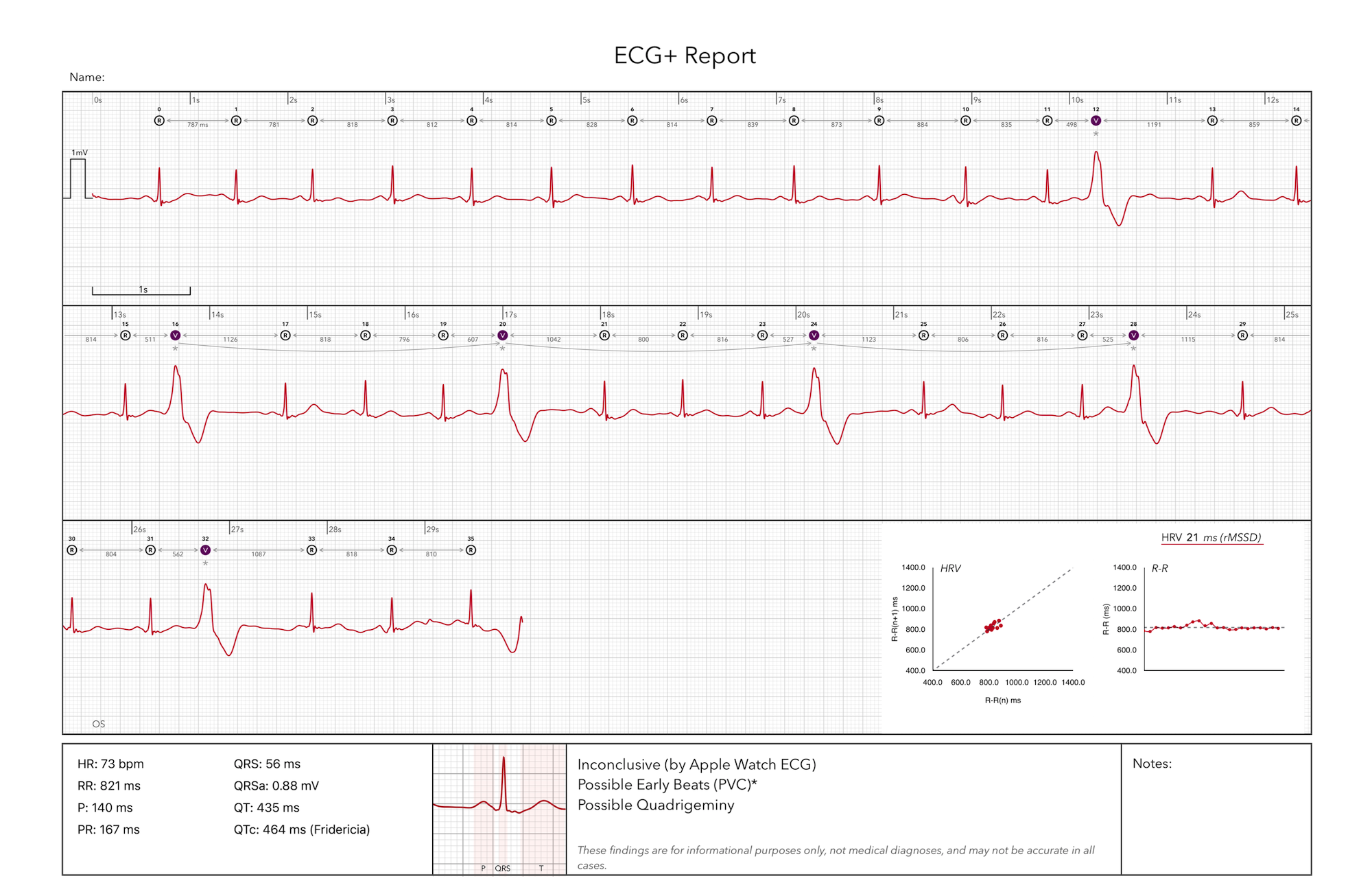
What to ask your doctor about your Apple Watch ECG findings
Use the findings in your ECG+ report as a starting point. Here are questions worth asking, depending on what ECG+ has flagged:
If ECG+ found PVCs or PACs:
- Are these findings clinically significant given how often they appear in my recordings?
- Is there anything in my lifestyle or medications that might be contributing?
- At what point would you want me to come back, or do further tests?
If ECG+ flagged AFib:
- Can you confirm this on a 12-lead ECG or a Holter monitor?
- Do I need to start any treatment, or should we monitor it first?
- Are there lifestyle changes I should make right away?
If ECG+ showed a raised QTc:
- Can we confirm this with a 12-lead ECG, given the limitations of single-lead measurement?
- Could any of my current medications be affecting my QT interval?
- Should I check my electrolyte levels?
General questions worth asking:
- Do these recordings show anything that needs further investigation?
- How often should I be taking recordings, and what should I watch for?
- Is there anything in this data that changes how you think about my cardiac health?
How to share your Apple Watch ECG report with your doctor
ECG+ lets you export a PDF report of your recordings, including waveform images, labelled findings, interval data, and session history. You can share it directly from the app by email, AirDrop, or print it before your appointment.
Bring the PDF or have it ready on your phone. Most doctors are familiar with Apple Watch ECGs and will appreciate having something concrete to look at.
What doctors can and can't do with Apple Watch ECG data
Your doctor cannot make a clinical diagnosis based on a single-lead ECG recording alone, and they will tell you this. That is not a limitation of you or ECG+; it is simply how cardiac diagnosis works. Single-lead recordings are useful for flagging things worth investigating further, not for replacing a full clinical workup.
What they can do is use your ECG+ data to decide whether further tests are warranted, track whether something is changing over time, and rule out things that don't need attention. That is exactly what the report is designed to support.